18V or 120V Table Saws? Compared by Specs
Compare 2 18V and 120V table saws by published specs. See how voltage and motor power affect cutting performance and safety features for your projects.
By GaugeKit Editorial Team 6 min read
As Amazon Associates, we earn from qualifying purchases. This means we may receive a small commission at no extra cost to you if you click through and make a purchase.
As an Amazon Associate we earn from qualifying purchases. Links on this page are affiliate links.
Choosing between an 18V vs 120V table saw depends on your power needs and workspace. Both tools offer precise cutting capabilities for various projects. The 18V model relies on battery power for portability, while the 120V option delivers continuous corded performance. You need to weigh runtime against raw power. This comparison highlights how voltage and motor type affect your daily workflow and cut quality.
Voltage
18V
120V
Motor Type
Brushless
1 1/2 HP
Blade Diameter
8-1/4"
not listed
Rip Capacity
12 in.
not listed
Safety System
not listed
Patented flesh-detection
Choose the first if
- You need a portable saw that runs on existing 18V batteries.
- You prioritize a lightweight design for frequent job site moves.
- You want fast RPMs for quick, accurate cuts in smaller materials.
Choose the second if
- You require continuous power without worrying about battery recharge times.
- You value advanced safety features that stop the blade instantly upon contact.
- You need a stable mobile cart assembly for a semi-permanent setup.
Verdict
The 18V RYOBI suits users who need portability and already own compatible batteries. The 120V SawStop is better for those prioritizing safety and uninterrupted power. Your choice depends on whether you value mobility or continuous performance.
18V vs 120V Table Saw Specs
Voltage and Power
Edge: SawStop Jobsite Saw PRO with Mobile Cart
The RYOBI model operates on 18V battery power, leveraging ONE+ HP Technology to mimic corded performance. This allows for up to 4,500 RPM when paired with two 4.0 Ah batteries. In contrast, the SawStop unit runs on standard 120V household electricity. It features a 1 1/2 HP motor, as noted in its key specs, though attributes list 2 HP. The 120V connection provides continuous power without the need to recharge batteries, making it suitable for longer jobs where downtime is not an option.
Blade Diameter
Edge: SawStop Jobsite Saw PRO with Mobile Cart
The RYOBI table saw is equipped with an 8-1/4-inch blade. This smaller diameter is common in compact, portable tools designed for lighter duties. The SawStop Jobsite Saw PRO uses a 12-inch blade, which is standard for full-size jobsite saws. A larger blade generally allows for deeper cuts and better handling of thicker materials. The difference in size reflects the intended use case, with the 12-inch option offering more versatility for demanding woodworking tasks compared to the smaller 8-1/4-inch alternative.
Rip Capacity
Edge: SawStop Jobsite Saw PRO with Mobile Cart
The RYOBI saw offers a 12-inch rip cut capacity to the right of the blade. This limits the width of sheet goods you can process without additional support. The SawStop model features a significantly larger table depth of 24 5/8 inches, which enhances accuracy and control during large cuts. While a specific rip capacity number is not provided for the SawStop in the data, the expansive table surface suggests it can handle wider materials more effectively than the 12-inch limit of the RYOBI unit.
Motor Type
Edge: Tie
The RYOBI tool utilizes a brushless motor, which is listed in its attributes. Brushless motors typically offer longer life and higher efficiency by eliminating carbon brushes. The SawStop specification lists a 1 1/2 HP motor in its key specs, but the attributes section contains conflicting data, listing both 2 HP and 1/2 HP. Because the motor type (brushless vs brushed) is not explicitly defined for the SawStop in the provided data, we cannot definitively compare the efficiency or maintenance requirements of the two motors.
Safety Features
Edge: SawStop Jobsite Saw PRO with Mobile Cart
The SawStop includes a patented flesh-detection safety system that detects contact with skin and stops the blade in under 5 milliseconds. This feature is designed to prevent serious injury and is a significant advantage for user safety. The RYOBI product data does not mention any active flesh-detection technology. It does include table-mounted push stick storage, which promotes safe handling of materials, but it lacks the automatic braking mechanism found in the SawStop model.
Portability and Size
Edge: RYOBI 18V Brushless 8-1/4-Inch Table Saw
The RYOBI saw is compact, measuring 20 inches in length and 12 inches in width. It is designed for portability and ease of storage. The SawStop is much larger, with dimensions of 48 inches in length and 29 inches in width when set up. However, it comes with a mobile cart assembly that allows for compact stowed dimensions of 26.5 inches in length. The RYOBI is inherently smaller and lighter, making it easier to carry manually, while the SawStop requires a cart for transport.
Which 18V or 120V Table Saw Fits You
Carpenters needing high power and safety
Our pick: SawStop Jobsite Saw PRO with Mobile Cart
You need the SawStop 120V model for continuous corded performance and robust 1 1/2 HP motor power. The patented flesh-detection safety system stops the blade in under 5 milliseconds, preventing serious injury. The mobile cart assembly allows for easy transport and storage, while the 24 5/8-inch table depth enhances accuracy during large cuts.
DIyers valuing portability and battery life
Our pick: RYOBI 18V Brushless 8-1/4-Inch Table Saw
Choose the RYOBI 18V brushless table saw for cordless convenience. It delivers up to 4,500 RPM and can rip 240 linear feet per charge using two 4.0 Ah batteries. The compact steel frame and rack and pinion adjustment ensure accurate depth control. Its lightweight design makes it ideal for jobsites where power outlets are scarce.
Users prioritizing precise fence alignment
Our pick: RYOBI 18V Brushless 8-1/4-Inch Table Saw
The RYOBI model features an adjustable self-aligning fence system for controlled, accurate cuts. The rack and pinion blade height adjustment provides precise depth control. With an 8-1/4-inch blade diameter and 12-inch rip capacity, it handles standard woodworking tasks efficiently. The table-mounted push stick storage keeps accessories secure during operation.
| # | Product | Best for | Price |
|---|---|---|---|
| 1 | RYOBI 18V Brushless 8-1/4-Inch Table Saw | portable 18V cutting with steel frame durability | |
| 2 | SawStop Jobsite Saw PRO with Mobile Cart | Jobsite users needing 120V power and safety |

RYOBI 18V Brushless 8-1/4-Inch Table Saw
Best for: portable 18V cutting with steel frame durability
- Voltage
- 18V
- Blade Diameter
- 8-1/4"
- Rip Capacity
- 12 in.
- Fence System
- Adjustable self-aligning
- Motor Type
- Brushless
- Dimensions
- 20 × 12 × 24 inches
This 18V table saw uses ONE+ HP technology to deliver corded-like performance. It features a brushless motor that spins an 8-1/4-inch blade up to 4,500 RPM. The steel frame supports a 12-inch rip capacity to the right of the blade. A rack and pinion system ensures accurate depth control. You get up to 240 linear feet of rip cuts per charge with two 4.0 Ah batteries. This tool suits users who need portable power without a cord.
- Brushless motor delivers up to 4,500 RPM for fast cuts.
- 12-inch rip capacity to the right of the blade.
- Rack and pinion blade height adjustment for precise depth control.
- Steel frame construction adds durability and strength.
- 8-1/4-inch blade diameter is smaller than the 10-inch blades found on standard 120V saws.
- 12-inch rip capacity is limited compared to the wider capacity of full-size 120V table saws.
- Requires two 4.0 Ah batteries to achieve the stated 240 linear feet of runtime.
- You need a portable saw that runs on 18V batteries.
- You require a steel frame for added durability on job sites.
- You want a brushless motor for efficient power delivery.
- You need a 10-inch blade for standard sheet goods.
- You prefer a corded 120V saw for unlimited runtime.
- You require a rip capacity wider than 12 inches.
Verdict: RYOBI 18V HP 8-1/4" Brushless Table Saw offers portable power for users who prioritize battery flexibility and a steel frame over the larger blade size and wider rip capacity of corded 120V models.
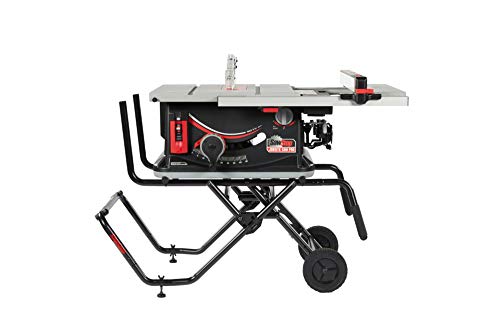
SawStop Jobsite Saw PRO with Mobile Cart
Best for: Jobsite users needing 120V power and safety
- Voltage
- 120V
- Motor Power
- 1 1/2 HP
- Stand Type
- Mobile Cart Assembly
- Application
- Jobsite
- Dimensions
- 48 × 29 × 36 inches
- Weight
- 113 pounds
The SawStop Jobsite Saw PRO is a 120V table saw with a 1 1/2 HP motor mounted on a mobile cart. It features a 24 5/8-inch table depth for large cuts and a one-turn elevation system for quick adjustments. The unit weighs 113 pounds and includes patented flesh-detection safety technology. This 120V model suits jobsite users needing high power and advanced safety features in a portable format.
- 120V power with 1 1/2 HP motor
- Patented flesh-detection safety system stops blade in under 5 milliseconds
- 24 5/8-inch table depth enhances accuracy
- One-turn elevation system for fast adjustments
- Mobile cart assembly for transport
- Heavier build at 113 pounds
- Larger stowed dimensions (26.5" L × 29" W × 45" H) compared to compact 18V alternatives
- You need 120V power for heavier cutting tasks
- You value advanced safety features like flesh detection
- You require a mobile cart for jobsite transport
- You prefer lighter, battery-powered tools under 20 pounds
- You need a smaller footprint for tight storage spaces
- You only require 18V voltage for light duty
Verdict: SawStop 120V Jobsite Saw PRO is a robust choice for professionals who prioritize safety and power on the jobsite. Its heavy weight and larger dimensions make it less ideal for those needing ultra-portable, lightweight equipment.
Specifications side by side
| Spec | RYOBI 18V Brushless 8-1/4-Inch Table Saw | SawStop Jobsite Saw PRO with Mobile Cart |
|---|---|---|
| Blade Diameter | 8-1/4" | – |
| Rip Capacity | 12 in. | – |
| Motor Power | – | 1 1/2 HP |
| Voltage | 18V | 120V |
| Fence System | Adjustable self-aligning | – |
| Stand Type | – | Mobile Cart Assembly |
| Motor Type | Brushless | – |
| Horsepower | – | 2 HP |
| Application | – | Jobsite |
| Dimensions | 20 × 12 × 24 inches | 48 × 29 × 36 inches |
| Weight | – | 113 pounds |
| Color | Green | Black |
| Model | PBLTS01B | JSS-120A60 |
Frequently asked questions
Is 18V or 120V better for rip cuts?
120V models generally handle larger rip cuts better due to higher continuous power. The SawStop 120V unit offers a 1/2 HP motor and a wider rip capacity, making it ideal for long, straight cuts on sheet goods. The 18V RYOBI model is less suited for heavy ripping tasks.
Which table saw is more portable?
The 18V RYOBI model is significantly more portable. It measures 20 inches in length and 12 inches in width, fitting easily into vehicles. The 120V SawStop is much larger, measuring 48 inches long and 29 inches wide, and weighs 113 pounds, requiring a dedicated cart for transport.
Does the 18V saw have a steel frame?
Yes, the RYOBI 18V Brushless 8-1/4-Inch Table Saw features a steel frame. This construction provides durability and stability for portable use. The 120V SawStop model does not specify a steel frame in its attributes, focusing instead on its robust motor and safety features for jobsite environments.
What is the maximum blade size for each?
The RYOBI 18V model uses an 8-1/4-inch blade diameter. The 120V SawStop Jobsite Saw PRO typically uses a 10-inch blade, though the data does not explicitly list the diameter. The larger blade on the 120V unit allows for deeper cutting capacity compared to the smaller 18V option.
Is a brushless motor better than a brushed one?
Brushless motors generally offer longer life and higher efficiency. The RYOBI 18V saw includes a brushless motor, which can help maximize battery runtime and performance. The 120V SawStop model attributes list horsepower but do not specify the motor type, so its efficiency characteristics are not detailed in the provided data.
Which saw is safer for beginners?
The 120V SawStop model includes a patented flesh-detection safety system. This feature stops the blade in under 5 milliseconds upon contact with skin, reducing injury risk. The RYOBI 18V model does not mention such a safety mechanism in its attributes, relying instead on standard operational precautions.
How much space do these saws need?
The 120V SawStop requires more floor space, measuring 48 inches long and 29 inches wide. The 18V RYOBI is more compact at 20 inches long and 12 inches wide. You need adequate room for the SawStop’s cart and material support, while the RYOBI fits in smaller workspaces.
See also
Where to buy
at Amazon
Price taken from the listing when this page was written and it can change at any time. We may earn a commission if you buy through this link.
More Table Saws
See the section


Get our picks by email
New reviews and the prices we spotted, once a week.