PINGEQUA Stick-RF 424: A Beginner’s Radio Module for M5StickC Plus 2
Exploring wireless hardware communication often feels overwhelming for parents, educators, and electronics novices who are looking to step into embedded engineering. When working with a compact IoT development computer like the m5…
By Reid Wallace 9 min read


Our verdict
Scores are out of 10, based on listed specifications and buyer feedback — not from testing of our own
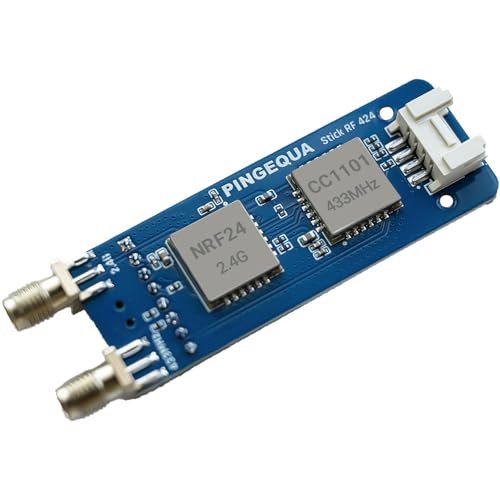
The PINGEQUA Stick-RF 424 stands out as a focused physical extension that simplifies radio frequency experimentation for beginners using compatible microcontrollers. It provides a sturdy backpack-style casing and dual internal chips, making it straightforward to explore wireless transmission without getting bogged down by electrical wiring or complex circuit breadboarding.
- Dual-chip architecture allows testing multiple radio configurations on one board
- Mechanical slide switch isolates data buses to prevent hardware signal collisions
- Custom resin-style 3D printed enclosure protects sensitive pins during desktop use
- Direct GPIO connectivity eliminates loose jumper wires and soldering irons
Where to buy
at Amazon Prime
Price taken from the listing on 18 Sep 2026 and it can change at any time. We may earn a commission if you buy through this link.
Pros
- Direct plug-in connection using standard GPIO
- Dual-chip architecture on a single expansion board
- Mechanical slide switch eliminates bus collisions
- Low-noise PCB with stable power management
- Includes protective resin-style 3D printed case
Cons
- Host M5Stick computer must be purchased separately
- Listing does not specify exact frequency bands
- Requires programming knowledge to configure radio tasks
As Amazon Associates, we earn from qualifying purchases. This means we may receive a small commission at no extra cost to you if you click through and make a purchase.
Exploring wireless hardware communication often feels overwhelming for parents, educators, and electronics novices who are looking to step into embedded engineering. When working with a compact IoT development computer like the m5 stick c plus 2, attempting to add external wireless capabilities often requires a maze of delicate jumper wires, breadboards, and messy external components. The PINGEQUA Stick-RF 424 is designed to eliminate that benchtop clutter by mounting directly onto the host device as a self-contained radio frequency module. It gives learners and hobbyists a clean way to transmit and receive wireless signals for introductory STEM experiments without risking damaged pins or short circuits.
Our research into this unit shows that it offers a very tidy, physically sound approach for anyone seeking an accessible radio frequency add-on. While shoppers must realize that this is strictly a blank-canvas accessory rather than a standalone gadget, its smart isolation switch and sturdy enclosure make it an appealing learning platform. For students and creators eager to explore basic signals without soldering, this add-on provides an organized route into radio engineering.
PINGEQUA Stick-RF 424 Features Explained
Dual-Chip Hardware Architecture
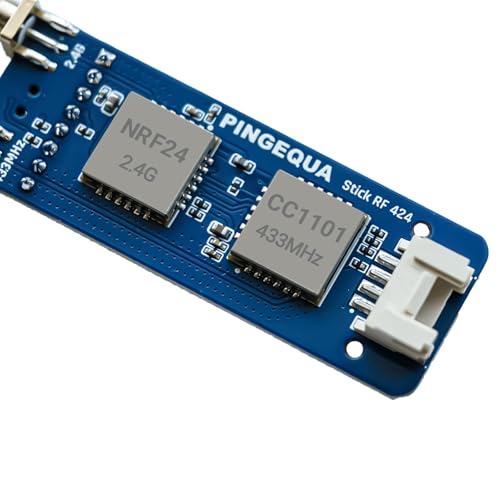
At the center of this expansion board is an integrated dual-chip setup arranged on a single piece of printed circuit board. In traditional electronics kits, testing two different microchips or alternative radio paths usually means wiring two distinct breakout boards together or manually swapping hardware on a workbench. The dual-chip rf module m5stickc configuration mounts both standard microchips directly to the board, giving users a neat, dual-channel foundation to explore different wireless behaviors through a single accessory.
This dual-microchip approach makes it easy for students to experiment with basic Internet of Things (IoT) principles without managing a tangled web of separate accessories. Connecting this m5 stick c plus 2 rf module directly through the standard GPIO interface allows beginner coders to focus on understanding data transmission logic rather than tracking down faulty wire jumpers. It serves as a physical sandbox where learners can explore dual-band hardware connectivity and understand how distinct radio chips process inputs.
Physical Isolation Hardware Switch
One of the smartest elements included on the PINGEQUA Stick-RF 424 is its physical slide switch. In microcontroller development, running multiple communication components over shared hardware data buses can easily lead to bus contention, signal collisions, or unexpected software crashes. Instead of forcing beginners to write complex software routines or firmware multiplexers to mute one chip while reading the other, the stick-rf 424 hardware switch mechanically disconnects one chip when the other is active.
This physical isolation ensures absolute hardware separation between the two integrated chips, guaranteeing zero data bus conflicts during live testing. For classroom environments where beginners are still learning the basics of signal flow, having a tangible toggle switch makes the state of the circuit visually obvious. You can slide the switch to the desired position and immediately know which physical chip is routed to your microcontroller, offering an intuitive, mistake-free learning cycle.
Optimized PCB Layout and Power Management
Radio frequency circuits are notoriously sensitive to electromagnetic noise and unstable power rails. The manufacturer redesigned this m5stack stickc plus 2 expansion board with an optimized printed circuit board (PCB) layout aimed specifically at reducing electrical interference. Clean copper routing and dedicated ground planes help isolate delicate radio paths from stray voltage spikes, which is crucial when trying to capture faint wireless signals in educational labs.
Complementing the clean board layout is an upgraded onboard power management system that regulates the incoming power line from the host computer. When programming experiments or monitoring data while tethered to a workstation like a microsoft surface pro laptop, stable power delivery prevents erratic reboots and signal distortion. This rock-solid hardware stability gives young engineers and students reliable test results without chasing phantom glitches caused by dirty electrical power.
Precision Antenna Tuning and Signaling
Transmitting and receiving wireless packets requires careful attention to impedance matching, an engineering discipline where the antenna and trace impedance must match the output stage of the transmitter. Without proper impedance matching, radio energy bounces back into the circuit, diminishing transmission range and degrading signal clarity. The PINGEQUA Stick-RF 424 features strictly impedance-matched antennas alongside high-grade passive components to provide steady, repeatable electrical signaling.
This precise component tuning makes the board a superb instructional aid for demonstrating basic radio frequency circuit principles. Students can observe how radio waves propagate and how clean component matching affects packet reception without dealing with mismatched DIY wire antennas. By packaging carefully tuned antennas on-board, the unit removes the guesswork and ensures that introductory experiments behave consistently from one lab session to the next.
Protective 3D-Printed Backpack Enclosure
Bare circuit boards are inherently vulnerable on a crowded student desk, where stray screws, metal pens, or accidental drops can easily short out delicate traces or bend header pins. The stick-rf 424 for beginners comes ready to handle laboratory conditions thanks to an included custom resin-style 3D printed case. This enclosure wraps around the module in a backpack form factor, holding the PCB firmly against the host unit while shielding the sensitive passive components and antennas.
The backpack enclosure does not just protect against drops and shorts; it also gives the assembled device a cohesive, finished feel that feels comfortable in the hand. Rather than looking like an intimidating, fragile bundle of electronic scrap, the assembled unit looks and handles like a polished field instrument. This rugged physical shell makes it far more inviting for middle schoolers, high schoolers, and adult beginners who might otherwise be intimidated by bare silicon boards.
Specs
Understanding the technical parameters of an expansion board ensures you pick the right parts for your workspace. Below is the full breakdown of pingequa stick-rf 424 specs based on the manufacturer’s verified hardware documentation:
| Brand | PINGEQUA |
|---|---|
| Model Name | PINGEQUA Stick-RF 424 |
| Connectivity Technology | GPIO |
| Wireless Compatibility | Radio Frequency |
| Compatible Devices | M5Stick Cplus 1.1 and 2 |
| Operating System Support | M5Stack OS |
| Hardware Architecture | Dual-chip design with physical slide switch |
| Included Components | Stick-RF 424 module, 3D printed case, user manual |
| Unit Count | 1 Count (1 pack) |
| Host Unit Included | No (StickC Plus 2 host unit sold separately) |
As published by the manufacturer on the Amazon listing.
Buy it if
Best Use Cases
- Classroom STEM demonstrations where educators want to illustrate physical radio switching without running jumper wires.
- Introductory IoT coursework where students write code to transmit simple sensor data over radio frequencies.
- Desktop hardware development for hobbyists who need a compact, protected wireless test node for basic prototyping.
- Dual-band signal experiments where users need to alternate between two separate microchips without experiencing bus collisions.
Think twice if
Before You Buy
Before purchasing this radio module, the single most crucial factor to understand is that it cannot operate on its own. The product package includes the 2-in-1 Stick-RF 424 board, the 3D-printed case, and a user manual, but the listing explicitly notes that the host microcontroller is not included. To use this accessory, you must already own or separately acquire an M5StickC Plus 1.1 or an m5 stick c plus 2 host device. Think of this module like adding an advanced flight stick like the thrustmaster hotas 4 to a gaming console; the peripheral provides specialized input and function, but it relies entirely on the core computer to process data and supply electrical power.
Additionally, buyers should take note of what the listing does not specify regarding frequency bands and internal silicon. While the product is marketed as an m5 stick c plus 2 radio frequency kit capable of dual-band connectivity, the manufacturer does not specify the exact chip model numbers, exact sub-gigahertz frequency values, or maximum transmission range in the product specifications. Because it is described as a blank-canvas hardware accessory running on M5Stack OS, you will need to supply your own code or community firmware sketches to execute specific radio operations. If you are gifting this to a complete newcomer, ensure they are comfortable with standard microcomputer programming environments, or pair it with an introductory robotics book.
Bottom Line
When considering the question of whether is the stick-rf 424 worth it, the answer depends entirely on your project goals and whether you already have an M5Stick base unit. For electronic beginners and STEM teachers seeking an orderly, solder-free method to teach wireless concepts, this expansion board provides tremendous value. Its combination of a physical slide switch, noise-isolated PCB layout, and snap-on protective shell turns a fragile microcontroller into a robust portable experimenter. Much like adding a smart streaming player such as a fire tv plus to an existing television simplifies home entertainment, this module streamlines radio frequency experimentation without breadboard headaches.
However, if you expect an out-of-the-box wireless gadget that performs automated tasks without programming, this is not that kind of consumer appliance. It is a genuine blank-canvas development tool that demands an M5StickC host and custom coding to bring its dual chips to life. For curious students, makers, and educators who want a reliable hardware playground to investigate radio waves, the PINGEQUA Stick-RF 424 is an exceptionally neat, well-engineered addition to your electronic workbench.
FAQ
Does the PINGEQUA Stick-RF 424 work as a standalone device?
No, the PINGEQUA Stick-RF 424 cannot operate as a standalone unit. It is an expansion backpack designed specifically to mount onto an M5StickC Plus 1.1 or M5StickC Plus 2 microcontroller via its GPIO connector. The host device provides the necessary processor, display, battery power, and programming interface required to operate the radio module.
How does the physical slide switch prevent data bus conflicts?
The physical slide switch acts as a hardware isolator between the two on-board microchips. By mechanically toggling the connection between the chips, the board prevents electrical conflicts and data bus contention. This design allows users to switch between two different hardware paths without writing complex software routines or rewiring physical connections.
Is soldering required to assemble this expansion module?
No soldering is required to use this module. It is engineered with a direct GPIO pin connection that slots straight into the compatible M5Stick host computer. Furthermore, it comes with a custom 3D-printed resin enclosure that securely fastens the board to your device, providing a completely solder-free, plug-and-play hardware experience.
What operating system and software does the board support?
The board is designed to interface with M5Stack OS through compatible development environments. Users can write programs, upload community scripts, or use standard visual block programming environments supported by the M5Stack ecosystem to control the GPIO lines and interact with the radio components.
What comes inside the product package?
The package contains the 2-in-1 Stick-RF 424 module, a custom 3D-printed resin-style protective case, and an official user manual. It does not include the base M5StickC computer, USB-C charging cables, or external development sensors.
Where to buy
at Amazon Prime
Price taken from the listing on 18 Sep 2026 and it can change at any time. We may earn a commission if you buy through this link.
More PC Components & Storage
See the section


Get our picks by email
New reviews and the prices we spotted, once a week.