Orange Pi 5 Max 8GB Review: A Beginner Guide to This Powerful Tiny PC
Finding a capable mini computer for DIY learning, home media streaming, or everyday desktop tasks often leaves beginners stuck between underpowered educational boards and bulky, energy-draining desktop towers. A single-board computer packs…
By Jasmine Norris 9 min read


Our verdict
Star rating left by Amazon buyers — not a score from testing of our own
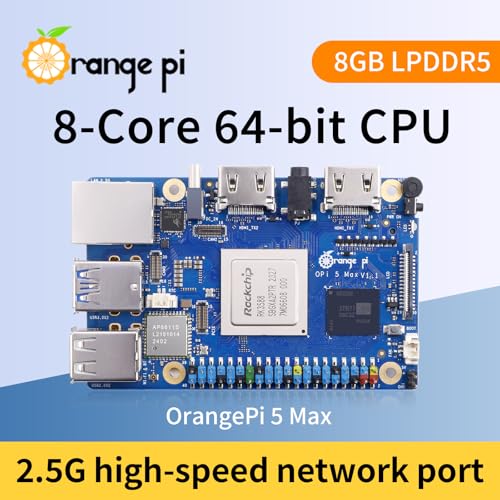
The Orange Pi 5 Max 8GB stands out as a high-performance single-board computer that delivers responsive multitasking and advanced video decoding in a tiny physical footprint. It successfully bridges the gap between basic educational circuit boards and full desktop computers, making it an excellent platform for home entertainment, light productivity, and hands-on coding experiments.
- Eight-core Rockchip processor handles multitasking, desktop apps, and coding environments with ease.
- Generous 8GB of modern LPDDR5 memory keeps intensive computing tasks responsive.
- Dual HDMI 2.1 display support with 8K video decoding creates an exceptional home theater experience.
- Modern networking includes a fast 2.5G Ethernet port alongside integrated Wi-Fi 6E and Bluetooth 5.3.
Where to buy
at Amazon
Price taken from the listing on 18 Sep 2026 and it can change at any time. We may earn a commission if you buy through this link.
Pros
- Fast Rockchip RK3588 8-core processor
- Spacious 8GB LPDDR5 system memory
- Dual HDMI 2.1 with 8K decoding
- High-speed 2.5G Ethernet and Wi-Fi 6E
- Onboard M.2 slot for NVMe SSDs
- Includes official 5V 5A power adapter
Cons
- Protective case and fan not included
- Requires flashing an operating system to boot
- HDMI display cables sold separately
As Amazon Associates, we earn from qualifying purchases. This means we may receive a small commission at no extra cost to you if you click through and make a purchase.
Finding a capable mini computer for DIY learning, home media streaming, or everyday desktop tasks often leaves beginners stuck between underpowered educational boards and bulky, energy-draining desktop towers. A single-board computer packs the core brain of a traditional computer onto a single circuit board roughly the size of a playing card, making it an exciting starting point for curious hobbyists, parents, and students. If you are shopping for a tech-minded loved one or venturing into home projects yourself, the Orange Pi 5 Max 8GB provides a remarkably potent microcomputing platform that balances compact dimensions with serious processing capabilities.
In this Orange Pi 5 Max 8GB review, we examine how this miniature powerhouse handles everyday software, ultra-high-definition media playback, and hardware tinkering. While microcomputers can seem intimidating due to their exposed circuit boards and technical jargon, this unit pairs modern wireless networking and high-definition video playback with an eight-core processor that keeps operating systems responsive. For anyone wanting to assemble a compact media center, a quiet home server, or an entry-level coding station, it delivers the raw speed needed to keep projects running smoothly without hitting annoying performance walls.
Orange Pi 5 Max 8GB Features Explained
Rockchip RK3588 Processor and Daily Computing Performance
At the center of this miniature computer sits the Rockchip RK3588 system-on-chip, an eight-core 64-bit processing engine manufactured with an efficient 8nm process. For beginners unfamiliar with processor architecture, think of this chip as an eight-lane highway divided into two specialized teams. Four high-performance Cortex-A76 cores operate at clock speeds reaching up to 2.4GHz to drive heavy workloads like compiling software or opening complex web pages, while four energy-saving Cortex-A55 cores run at 1.8GHz to manage background duties. When evaluating the Orange Pi 5 RK3588 performance, this balanced structure keeps the system snappy while consuming only a fraction of the electricity used by a full-size desktop computer.
Visual tasks and graphical interfaces are handled by an integrated ARM Mali-G610 3D graphics engine that supports modern programming standards such as Vulkan 1.2, OpenCL 2.2, and OpenGL ES 1.1, 2.0, and 3.2. This built-in graphics hardware allows the board to effortlessly render graphical desktop environments, display smooth window animations, and run casual games without needing an expensive dedicated graphics card. Whether you are running a friendly desktop operating system like Ubuntu or introducing a student to coding through Scratch, the underlying processor architecture ensures responsive feedback across your screen.
LPDDR5 System Memory and Advanced Video Decoding
The Orange Pi 5 8GB comes equipped with 8GB of modern LPDDR5 system memory, providing a spacious digital workspace for active applications. In personal computing, system memory acts as a quick-access desk where running programs keep their temporary data. Having 8GB of memory means you can browse websites with multiple open tabs, stream media, and run background server software at the same time without the sluggish slowdowns common on boards with only 1GB or 2GB of memory. The LPDDR5 standard also provides higher data transfer bandwidth than older memory generations, speeding up overall system responsiveness.
Video processing is another area where this board truly shines, offering dedicated hardware decoding that supports video resolutions up to 8K at 60 frames per second. Dual HDMI 2.1 output ports let you connect two modern high-resolution screens simultaneously, making it great for dual-monitor setups or interactive digital displays. For anyone building a dedicated Orange Pi 5 media center in their living room, the onboard video codec handles high-bitrate video streams effortlessly, freeing the central processor to keep playback menus and background downloads running without stuttering.
Dedicated Artificial Intelligence Edge Computing
A notable highlight within the Orange Pi 5 specs is the embedded Neural Processing Unit, commonly referred to as an NPU. While general-purpose processors calculate tasks sequentially, an NPU specializes in parallel mathematical operations designed specifically for artificial intelligence algorithms. This onboard unit delivers up to 6TOPS of processing power, supporting hybrid computing across INT4, INT8, INT16, and FP16 data types. For students and tech hobbyists, having hardware-accelerated AI on a single small board makes experimenting with smart camera vision and local voice recognition accessible without relying on paid cloud services.
In practical home projects, this dedicated edge computing power allows the mini computer to analyze real-time video feeds for motion tracking, identify objects, or process sensor inputs directly on the device. Because all data calculations take place locally on the circuit board, your privacy is protected and network latency disappears. While specialized enterprise boards like the orin nano super cater to industrial robotics, having 6TOPS built into an accessible maker board gives home tinkerers a great platform to learn embedded machine learning fundamentals.
Next-Generation Networking and Wireless Connectivity
Staying connected to local networks, internet streams, and peripheral devices is simple thanks to the broad array of networking standards built directly onto the circuit board. For wired home networks, the board features a PCIe-extended 2.5G Gigabit Ethernet port. Standard home computers frequently feature traditional 1.0G network jacks, so a 2.5G connection delivers substantially faster file transfer speeds when connected to modern home routers and network storage devices. This added bandwidth makes moving large home video backups or streaming heavy media files far quicker.
Wireless communication is equally well-appointed, incorporating Wi-Fi 6E alongside Bluetooth 5.3 with Low Energy support. Wi-Fi 6E operates across the 6GHz wireless frequency band, avoiding the network congestion often found on crowded 2.4GHz and 5GHz household bands to deliver stable wireless internet connections. Bluetooth 5.3 ensures dependable pairing with wireless keyboards, mice, audio headphones, and game controllers. Having both high-speed wired and modern wireless connectivity integrated into the board eliminates the hassle of purchasing external USB adapters.
Expansive Physical Ports and Storage Interfaces
Despite measuring roughly 3.5 inches long and 2.2 inches wide, the board offers a wide selection of physical ports for connecting equipment and peripherals. You get four full-sized USB ports consisting of two high-speed USB 3.0 connections for fast external hard drives and two standard USB 2.0 ports ideal for everyday keyboards and mice. Audio capabilities include a 3.5mm headphone jack with microphone input support, an onboard microphone header, and HDMI 2.1 audio return channel functionality. In addition, an onboard 40-pin GPIO interface lets hobbyists connect external sensors, small motors, and status lights for custom electronics projects.
Storage flexibility is another major asset for users who prioritize fast boot times and reliable file storage. In addition to a standard MicroSD card slot and 16MB of QSPI Nor flash, the board includes an onboard M.2 M-Key slot with PCIe 3.0 4-lane support. This slot lets you install modern M.2 solid-state drives, supporting both NVMe and SATA SSD formats. Running your operating system and files from an M.2 SSD provides dramatically faster loading times than a regular memory card, keeping the entire desktop experience smooth and fluid.
Specs
| Processor (CPU) | Rockchip RK3588 8-core 64-bit (4x Cortex-A76 @ 2.4GHz, 4x Cortex-A55 @ 1.8GHz, 8nm process) |
|---|---|
| Graphics (GPU) | ARM Mali-G610 3D GPU (OpenGL ES 1.1/2.0/3.2, OpenCL 2.2, Vulkan 1.2) |
| AI Acceleration (NPU) | Up to 6TOPS computing power (supports INT4, INT8, INT16, FP16) |
| Installed RAM | 8 GB LPDDR5 |
| Storage Expansion | MicroSD card slot, M.2 M-Key slot (PCIe 3.0 4-Lane NVMe/SATA SSD), 32 GB capacity listed |
| Video Output | Dual HDMI 2.1 (up to 8K@60FPS), 1x MIPI DSI TX 4-Lane |
| Audio Interfaces | 3.5mm jack with mic input, onboard MIC header, ES8388 codec, HDMI 2.1 eARC |
| Network Connectivity | 1x 2.5G LAN port, Wi-Fi 6E, Bluetooth 5.3 with BLE support |
| USB Ports | 4 total (2x USB 3.0, 2x USB 2.0) |
| Dimensions & Weight | 89mm x 57mm x 1.6mm (3.5"L x 2.2"W x 0.5"H), 2 ounces |
As published by the manufacturer on the Amazon listing.
Buy it if
Best Use Cases
- Assembling a silent, ultra-compact 8K living room media center that plays high-definition video files smoothly over local networks.
- Creating an energy-efficient desktop workspace for web browsing, office document editing, and learning computer programming.
- Building a dedicated home network storage hub powered by fast 2.5G wired networking and responsive M.2 NVMe solid-state storage.
- Designing an entry-level artificial intelligence lab to experiment with real-time camera tracking and local computer vision models.
- Constructing a retro arcade console capable of running classic emulation software while powering dual monitors simultaneously.
Think twice if
Before You Buy
Before purchasing this compact computer, gift-givers and beginners should understand that single-board computers arrive as bare electronic circuit boards rather than enclosed retail gadgets. The retail box includes the main circuit board and an official Orange Pi 5V 5A Type-C power supply, but the listing does not specify an included protective enclosure, HDMI monitor cable, or cooling fans. Because the eight-core processor can generate significant warmth under continuous heavy processing or prolonged gaming, adding a basic protective case with passive heat sinks or a small cooling fan is a sensible precaution to ensure stable operation over time.
Setting up the software also requires some initial effort. The hardware supports operating systems including Ubuntu, Debian, Orange Pi OS, and Android 12, but no operating system comes pre-installed on the hardware. You will need access to another computer to download your chosen software image and write it to a MicroSD card or M.2 SSD. When comparing the Orange Pi 5 vs Raspberry Pi ecosystem, beginners should note that community forums and pre-configured starter images are slightly more widespread for alternatives like the raspberry pi 5 8gb ram, meaning you should be comfortable following online setup guides during your initial installation.
Bottom Line
When deciding whether the Orange Pi 5 is worth it for your specific DIY goals, the board delivers outstanding computing value through its combination of an eight-core processor, modern LPDDR5 memory, and expansive connectivity. For home tinkerers, learners, and hobbyists looking to build a media hub, custom network server, or home coding station, it supplies computing headroom that keeps projects performing reliably for years without running out of breath.
While the initial setup involves learning how to flash an operating system and sourcing a video cable, the end result is a capable, silent computer that fits neatly into the palm of your hand. As the broader single-board computing world evolves with future releases like the orange pi 6, this current generation provides an exceptionally mature, feature-complete platform that curious beginners can explore with confidence.
FAQ
Is the Orange Pi 5 for beginners easy to use?
While configuring a single-board computer requires downloading an operating system image to a memory card or SSD, using the board is quite straightforward once setup is finished. Beginners who follow clear step-by-step guides can easily run familiar operating systems like Ubuntu or Android 12 with standard mouse and keyboard controls.
What power supply does the Orange Pi 5 Max require?
The board requires a stable 5V 5A power source supplied through a standard USB Type-C port. Conveniently, this listing includes the official Orange Pi 5V 5A Type-C power adapter in the box, ensuring the processor receives consistent electrical power under demanding workloads.
Can this mini PC play 8K video content?
Yes, the Rockchip RK3588 processor includes a dedicated hardware video decoder capable of processing up to 8K resolution video at 60 frames per second. Dual HDMI 2.1 output ports also allow you to connect modern ultra-high-definition displays directly.
How does the Orange Pi 5 setup work for storage?
During your Orange Pi 5 setup, you can install the operating system onto a standard MicroSD card or an M.2 solid-state drive installed in the onboard M.2 slot. While MicroSD cards are easy to swap, using an M.2 NVMe SSD offers dramatically faster system boot times and file loading speeds.
Does the board include integrated Wi-Fi and Bluetooth?
Yes, the board includes integrated Wi-Fi 6E and Bluetooth 5.3 with Low Energy support. This allows you to connect to high-speed home wireless networks and pair wireless keyboards, mice, or game controllers without taking up any USB ports.
Where to buy
at Amazon
Price taken from the listing on 18 Sep 2026 and it can change at any time. We may earn a commission if you buy through this link.
More Computers & Laptops
See the section


Get our picks by email
New reviews and the prices we spotted, once a week.