The Simulation Holds: A Simple Guide to This Brief Philosophy Book
Grappling with deep questions about consciousness, reality, and perception often feels intimidating. For decades, academic philosophy has buried these fascinating topics beneath heavy jargon, dense historical references, and multi-volume texts that leave…
By Andrea Maddox 8 min read


Our verdict
Star rating left by 8 Amazon buyers — not a score from testing of our own
For anyone seeking a concise summary of modern philosophical and evolutionary skepticism, this book provides an engaging, jargon-free overview that readers can easily finish in an afternoon. It frames human consciousness not as a pristine window into the universe, but as an internal biological model built for survival rather than objective truth.
- Presents a short, readable philosophical meditation spanning 54 pages.
- Explores how sensory inputs, language, and culture filter our perception of daily reality.
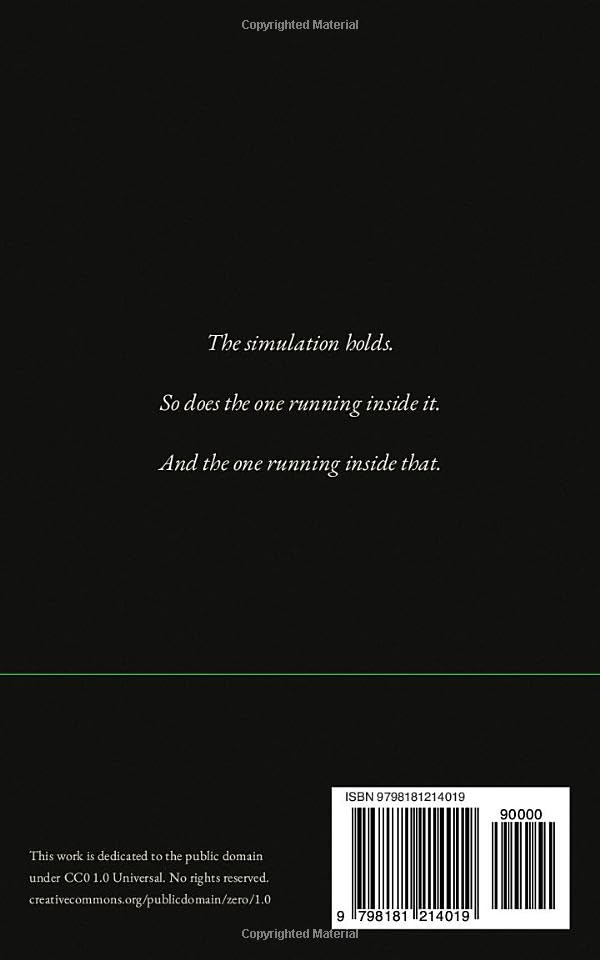
- Released freely into the public domain under a Creative Commons Zero dedication.
- Pocket-sized physical dimensions make it an easy companion for daily commutes or weekend reading.
Where to buy
at Amazon Prime
Price taken from the listing on 18 Sep 2026 and it can change at any time. We may earn a commission if you buy through this link.
Pros
- Quick reading time under an hour
- Concise 54-page physical format
- Dedicated to public domain under CC0
- Lightweight and pocket-friendly dimensions
- Clear focus on perception and evolutionary modeling
Cons
- Very brief 54-page length
- Lacks traditional index or extensive reference list
- Publication date listed far in advance
As Amazon Associates, we earn from qualifying purchases. This means we may receive a small commission at no extra cost to you if you click through and make a purchase.
Grappling with deep questions about consciousness, reality, and perception often feels intimidating. For decades, academic philosophy has buried these fascinating topics beneath heavy jargon, dense historical references, and multi-volume texts that leave newcomers feeling exhausted before finishing the opening chapter. Curious general readers and gift shoppers wanting to give someone a spark of intellectual inspiration frequently search for accessible entry points that cut straight to the core questions of existence without requiring a background in epistemology. In this detailed review of The Simulation Holds, we explore a streamlined philosophical essay designed to tackle fundamental questions about how our biological machinery constructs the world around us.
Our verdict is that this title stands out as a remarkably accessible, brief meditation on perception and modern culture. Instead of presenting a dense textbook, the author strips away institutional pretension to deliver a focused critique of how human perception actually works. By examining sensory limits, evolutionary adaptations, and linguistic frameworks, the book offers an engaging entry point that respects your time. It works brilliantly for first-time philosophy readers, students, and anyone looking for an intellectual gift that delivers deep ideas in a readable package.
The Simulation Holds Features Explained
The Brain as an Internal Simulation Engine
The central pillar of the book revolves around the evolutionary argument that human perception is an internal simulation rather than direct access to the world. When light hits your eyes or sound waves strike your eardrums, your brain does not present raw reality to your conscious mind. Instead, your nervous system synthesizes these inputs into a predictive model shaped by four hundred million years of evolutionary pressures. Natural selection never prioritized showing organisms total metaphysical reality; it prioritized keeping our ancestors alive long enough to reproduce.
In this sense, human experience behaves very much like real-time rendering software. Much like how virtual simulation programs such as microsoft flight simulator 2024 pc render only the data necessary to convince a pilot within cockpit constraints, our biological sensory apparatus produces a streamlined interface that hides the overwhelming complexity of subatomic physics. By explaining this concept through clear analogies, the author helps first-time philosophy readers understand why what we call reality is always a heavily edited biological rendering.
Linguistic and Cultural Filtering Mechanisms
Beyond biological limits, the author examines how social conditioning further warps our understanding of everyday events. Long before a human infant learns to articulate independent thoughts, they absorb an inherited language that dictates how categories, boundaries, and values are drawn. The words we use are not neutral labels; they are historical tools that structure how we segment our daily sensations and memories.
Cultural conditioning forms the second layer of this filtering apparatus. Society hands each individual a predetermined set of narratives, moral assumptions, and institutional norms that dictate what seems obvious or self-evident. When a perceived event reaches conscious awareness, it has already been sorted through these linguistic and societal templates. The text demonstrates that untangling our personal identity from these inherited scripts requires conscious effort and critical reflection.
The Nature of the Self and the Drive for Objective Truth
Another major theme explored throughout the text is the paradoxical nature of the human self. Most people experience life with an intuitive sense of an inner observer—an ego sitting behind the eyes directing attention and receiving thoughts. The author interrogates whether this self is an authentic entity or simply another construct generated by the internal simulation to help coordinate action and social standing.
Alongside the self, the essay questions humanity’s obsessive urge toward absolute objective certainty. We long for a bird’s-eye view of existence free from subjective distortion, yet our biological instruments ensure that every observation remains fundamentally anchored to our perspective. Much like navigating realistic transport physics in on the road truck simulator ps4, where every action is experienced strictly from behind the cab’s steering wheel, our perception of existence remains permanently seated in the driver’s perspective of human biology.
Public Domain Dedication and Open Distribution
A notable philosophical and ethical aspect of the publication is its legal status. The author has dedicated the work to the public domain under Creative Commons Zero (CC0), waiving all intellectual property rights. In a commercial landscape where ideas are routinely locked behind copyright paywalls and restrictive digital rights management, releasing a philosophical treatise into the public commons represents a distinctive statement.
For readers, educators, and discussion groups, this CC0 status means anyone is free to quote, reproduce, translate, or adapt the text without legal hurdles. It reinforces the author’s argument that ideas concerning reality, consciousness, and truth belong to humanity as a whole rather than being private commodities.
Compact Format and Physical Dimensions
Unlike bulky academic volumes that gather dust on a bookshelf, this paperback is deliberately engineered for portability. Measuring 5 by 8 inches with a slender thickness of just 0.14 inches, the physical object slips effortlessly into a jacket pocket, commuter backpack, or purse. Weighing only 2.26 ounces, it feels closer to an artisanal pamphlet or monograph than a cumbersome textbook.
This compact construction lowers the barrier to entry for readers who feel intimidated by longer philosophy books. It allows a reader to engage with profound metaphysical questions in short bursts, whether sitting on a train, waiting at an airport gate, or relaxing in a quiet park.
Specs
| Full Title | The Simulation Holds: On Reality, the Self, and the Fictions That Run Us |
|---|---|
| Publisher | Independently published |
| Publication Date | June 12, 2026 |
| Language | English |
| Print Length | 54 pages |
| ISBN-13 | 979-8181214019 |
| Item Weight | 2.26 ounces |
| Product Dimensions | 5 x 0.14 x 8 inches |
| Copyright License | Public Domain (Creative Commons CC0) |
As published by the manufacturer on the Amazon listing.
Buy it if
Best Use Cases
- A quick travel read for commuters who want an intellectually stimulating alternative to digital smartphone scrolling.
- A thoughtful and affordable gift idea for friends or family members who enjoy podcasts exploring neuroscience, psychology, and philosophy.
- A beginner-friendly introductory text for high school or college students starting to explore epistemology and cognitive theory.
- A short, debate-provoking discussion piece for monthly book clubs looking for a topic that can be read and debated in one evening.
Think twice if
Before You Buy
Before ordering, shoppers should pay close attention to the length and publication details of this text. With a modest length of 54 pages, this title is an extended essay or philosophical manifesto rather than an exhaustive academic survey. If you are expecting extensive historical footnotes, comparative breakdowns of ancient Greek philosophy, or hundreds of citations covering neurobiology, this brief volume will not meet those expectations. Instead, it prioritizes concise conceptual framing to get you thinking quickly.
The product listing also lacks several specific pieces of information that shoppers should keep in mind. The listing does not specify whether there is a bundled digital audiobook, an accompanying study guide, or an index at the end of the text. Furthermore, the listing displays a future publication date of June 12, 2026, so prospective buyers should verify edition availability prior to ordering. Much like choosing a compact street camera such as the fujifilm x100vi new, where fixed focal lengths trade total versatility for sharp, immediate creative focus, this book delivers a tight, distilled thesis rather than an all-encompassing philosophical compendium.
Bottom Line
For readers who appreciate big philosophical ideas without the accompanying academic bloat, this brief volume delivers a crisp, accessible critique of everyday perception. By demonstrating how our senses, languages, and cultures assemble an internal model of existence, it challenges readers to re-examine their daily assumptions about truth, identity, and the modern world.
Whether you are searching for a personal read to spark your curiosity or looking for a memorable, thoughtful gift idea for a reflective friend, its pocketable size and public domain spirit make it a unique addition to any personal library. It succeeds by asking deep questions clearly, leaving you with plenty of philosophical fuel to ponder long after turning the final page.
FAQ
What is the core premise of The Simulation Holds?
The core premise is that human beings do not directly perceive objective reality. Instead, our conscious minds inhabit an internal biological simulation constructed from sensory inputs that have been shaped across millions of years of evolutionary survival pressure, then further filtered through language and cultural expectations.
What is the typical reading time for this book?
Because the book spans 54 pages, most readers can comfortably finish the entire text in 45 to 75 minutes. Its short format makes it ideal for an afternoon reading session or a single commute.
Is this book suitable for beginners in philosophy?
Yes, the book is written in clear, direct prose that avoids dense academic jargon. It is specifically approachable for beginners, curious general readers, and high school or college students encountering epistemological concepts for the first time.
What does the Creative Commons CC0 dedication mean?
A CC0 dedication means the author has placed the text into the public domain, waiving all copyright protections worldwide. Readers and educators are legally permitted to copy, share, distribute, and quote from the text freely without seeking permission or paying licensing fees.
Does the book include illustrations, diagrams, or an index?
The listing does not specify whether the interior includes charts, anatomical diagrams of the nervous system, or a formal subject index. The book is presented primarily as a written prose essay focusing on conceptual arguments.
Where to buy
at Amazon Prime
Price taken from the listing on 18 Sep 2026 and it can change at any time. We may earn a commission if you buy through this link.
More TV & Home Theater
See the section




Get our picks by email
New reviews and the prices we spotted, once a week.