Choosing Wood Routers in 2026: The Specs That Matter and 8 Picks
Select the best wood router by comparing published specs like horsepower and base type across 8 models in this practical 2026 buying guide.
By GaugeKit Editorial Team 9 min read
As Amazon Associates, we earn from qualifying purchases. This means we may receive a small commission at no extra cost to you if you click through and make a purchase.
As an Amazon Associate we earn from qualifying purchases. Links on this page are affiliate links.
This wood router buying guide helps you select the right tool by focusing on published specifications rather than marketing claims. You will evaluate key metrics like horsepower, voltage, and base type to match your specific woodworking needs. The guide walks through the differences between corded and cordless models, as well as fixed and plunge configurations. You will learn how weight and dimensions affect your control during stationary or portable tasks.
We analyzed 8 products to identify the strongest options based on their technical data. The top picks include the Bosch 2.25 HP Fixed-Base Router for stationary work and the Milwaukee 18V Cordless Compact Router for portable detail work. Each recommendation is chosen strictly from its listed attributes, such as speed ranges and motor power. You can trust these selections because they are derived directly from the manufacturers' published specs, ensuring you get a tool that fits your workflow without guesswork.
Key Specs for Choosing Routers
Horsepower and motor strength
Horsepower determines the router's ability to handle large bits and dense hardwoods without stalling. Higher HP, such as 2-1/4 HP found in the Bosch 1617EVS, provides stable torque for heavy-duty tasks like edge profiling or table work. Lower HP units, like the Makita RT0701C at 1-1/4 HP, are sufficient for light trim work and delicate details. You must balance power needs with the tool's size and weight. More power often means a heavier, bulkier tool that is harder to maneuver for extended periods. Choose high HP for stationary router table use, and lower HP for handheld precision tasks.
Look for
- Check HP rating for your material density
- Verify motor type for efficiency
Corded vs cordless power source
Your choice between corded and cordless affects mobility and runtime. Cordless models, like the Milwaukee 2723-20, offer freedom from extension cords, ideal for job sites or large workshops. However, you must manage battery life and charging. Corded routers, such as the SKIL RT1322-00, provide continuous power without downtime, making them better for long, uninterrupted sessions. Cordless tools may lack the raw torque of their corded counterparts. Consider your workspace layout. If you frequently move between locations, a cordless 18V or 20V system is practical. For stationary bench work, corded reliability is superior.
Look for
- Confirm voltage for cordless models
- Assess cord length for corded units
Base type: fixed or plunge
The base type dictates how you control the bit depth. Fixed-base routers, like the DEWALT DW618, lock the bit at a set depth, offering stability for repetitive cuts or router table mounting. Plunge routers allow you to lower the spinning bit into the workpiece, essential for mortising or internal cutouts. Some kits, like the Bosch 1617EVSPK, include both bases for versatility. You must decide if you need the precision of a fixed base or the flexibility of a plunge mechanism. Using a fixed base for plunge tasks requires manual estimation, which risks accuracy. Match the base to your primary cutting style.
Look for
- Identify base type for your project style
- Check if both bases are included
Variable speed control
Variable speed allows you to adjust RPMs based on the bit size and material. Smaller bits require higher speeds to maintain cutting efficiency, while larger bits need lower speeds to prevent burning or kickback. The Bosch 1617EVS offers variable speed for this adaptability. Fixed-speed routers lack this flexibility, potentially limiting your bit choices or requiring slower feeds. You should look for models with electronic speed regulation to maintain RPM under load. This feature is crucial for working with different wood densities and bit diameters. It ensures cleaner cuts and extends bit life by preventing overheating.
Look for
- Verify variable speed range for bit compatibility
- Check for electronic speed regulation
Chuck size and bit capacity
Chuck size determines the shank diameter of bits you can use. Most routers accept 1/4-inch or 1/2-inch shanks. Larger chucks, often 1/2-inch, provide better grip and reduce vibration for heavy cuts, but may not fit smaller trim bits. You must check the maximum bit diameter the router can accommodate. A larger capacity allows for more aggressive material removal. However, it often adds weight and bulk. Ensure the chuck mechanism allows for easy bit changes while wearing gloves. Match the chuck size to your most frequently used bit types.
Look for
- Confirm shank size compatibility
- Check maximum bit diameter capacity
Weight and ergonomic design
Router weight significantly impacts control and fatigue. Heavier routers, like the Bosch 1617EVS at nearly 10 pounds, offer stability but can cause arm strain during overhead or prolonged use. Lightweight cordless models, such as the Makita XTR01Z, reduce fatigue but may lack power. You should consider the tool's balance and handle placement. Ergonomic handles improve grip and reduce vibration transfer. For portable work, lighter tools are preferable. For stationary use, heavier tools dampen vibration better. Evaluate the weight relative to your physical strength and the type of work you perform most often.
Look for
- Assess weight for your endurance
- Check handle comfort and balance
Included accessories and kit value
Many routers are sold as kits with additional bases or accessories. The Bosch 1617EVSPK includes both fixed and plunge bases, offering versatility without buying separate tools. You should evaluate if the kit includes necessary items like wrenches, dust shrouds, or spare collets. Buying individual components can be more costly. However, some kits include unnecessary items you will never use. Check the specific contents of each model. A comprehensive kit is valuable for beginners who need multiple base types. Professionals may prefer bare tools to select only the components they require.
Look for
- List included bases and accessories
- Verify if bare tool is available
Common Router Base Types
Fixed Base Routers
Fixed-base routers lock the motor at a set depth for consistent cuts. You adjust the bit height before inserting the motor into the base. This design offers superior stability and is ideal for router table use. The Bosch 1617EVS delivers 2.25 HP for stationary tasks. These tools excel at edge profiling and trimming. You sacrifice the ability to adjust depth while running. Choose this type when you need precision and repeatability for dedicated workspaces.
Plunge Routers
Plunge routers allow you to lower the spinning bit into the workpiece. This feature enables precise start points for mortising or inlay work. You can adjust depth on the fly during operation. The DEWALT DCW620B offers 2-1/4 HP in a cordless format for heavy-duty tasks. This flexibility comes with added weight and complexity. You manage more moving parts than a fixed base. Select this type when your projects require vertical entry points or variable depth cuts.
Combination Kits
Combination kits include both fixed and plunge bases in one package. You get the stability of a fixed base and the flexibility of a plunge mechanism. The Bosch 1617EVSPK provides 2.25 HP for versatile woodworking tasks. This setup saves space compared to buying two separate tools. You pay for the versatility and shared motor housing. The trade-off is often higher initial weight and cost. Choose this type if you need both functionalities without managing multiple separate bases.
Common Router Buying Mistakes
Ignoring base type requirements
Selecting a router without considering your primary use case leads to frustration. Fixed bases offer stability for table work, while plunge bases allow depth adjustment during cuts. Match the base mechanism to your intended projects to ensure precision and safety during operation.
Overlooking motor horsepower needs
Choosing a low-horsepower motor for dense hardwoods causes stalling and burnt bits. Higher HP provides consistent torque for large-diameter bits. Evaluate your typical material hardness and bit size to select a motor that maintains speed under load without overheating or struggling.
Neglecting variable speed control
Using a fixed-speed router for all bit sizes risks burning out small-diameter bits. Variable speed allows you to slow down for larger bits to prevent tear-out. Ensure the model you choose offers a wide speed range to match different bit diameters safely.
Forgetting about dust collection ports
Routers generate significant sawdust that obscures your work area and harms health. A model with a dedicated dust port connects to a vacuum system. Check for a compatible port size and shape to maintain visibility and keep your workshop cleaner during extended use sessions.
| # | Product | Best for | Price |
|---|---|---|---|
| 1 | Bosch 2.25 HP Fixed-Base Wood Router | stationary woodworking and router table use | |
| 2 | Milwaukee 18V Cordless Compact Router | Portable detail work and edge profiling | |
| 3 | Makita 18V Brushless Compact Router | portable precision and detailed trim work | |
| 4 | Bosch 2.25 HP Combination Router | Users needing versatile base options and high torque | |
| 5 | SKIL 14 Amp 2.5 HP Router Combo | Users needing fixed and plunge bases together | |
| 6 | Makita RT0701C 1-1/4 HP Fixed Router | precise fixed-base routing tasks | |
| 7 | DEWALT 20V MAX XR 2-1/4 HP Plunge Router | Heavy-duty cordless routing tasks | |
| 8 | DEWALT 2-1/4 HP Fixed Base Router | heavy-duty fixed-base routing tasks |

Bosch 2.25 HP Fixed-Base Wood Router
Best for: stationary woodworking and router table use
- Horsepower
- 2.25 HP
- Base Type
- Fixed-Base
- Speed Range
- 8000-25,000 RPM
- Amperage
- 12 AMP
- Speed
- Variable Speed
- Intended Use
- Woodworking
The Bosch 1617EVS is a 12-amp, 2.25 HP fixed-base router designed for woodworking. It features a variable speed range of 8,000 to 25,000 RPM and a constant response circuit to maintain torque under load. Weighing 9.92 pounds, it includes a threaded three-hole base pattern for table mounting and microfine depth adjustment. This tool suits users who need stable, high-power performance for precision cuts.
- 2.25 HP motor with 12-amp draw for ample power
- Variable speed dial adjusts from 8,000 to 25,000 RPM
- Constant response circuitry stabilizes torque under load
- Microfine bit-depth adjustment for precise settings
- Threaded three-hole base pattern for quick router table mounting
- Fixed base limits plunge routing capability compared to combo kits
- 9.92-pound weight is heavier than compact 18V cordless alternatives
- 25,000 RPM max speed is lower than some 24,000+ RPM models
- You need high torque for heavy material removal
- You plan to mount the router in a stationary table
- You prefer wired power for consistent performance
- You require plunge base functionality for mortising
- You prioritize lightweight, cordless portability
- You need variable speeds exceeding 25,000 RPM
Verdict: Bosch 1617EVS 2.25 HP Fixed-Base Router delivers robust power and precise control for stationary woodworking tasks. It is the right choice for users who value torque stability and table-mount compatibility over cordless convenience.

Milwaukee 18V Cordless Compact Router
Best for: Portable detail work and edge profiling
- Speed Range
- 10,000 – 31,000 RPM
- Power Source
- Cordless
- Voltage
- 18.0 V
- Motor Type
- Brushless
- Form Factor
- Compact
- Dimensions
- 4.79 × 3.23 × 6.86 inches
This Milwaukee compact router uses an 18.0 V cordless power source and a brushless motor. It offers a variable speed range of 10,000 to 31,000 RPM. The tool weighs 4.78 pounds and includes a Macro Adjust button for fast adjustments. It suits users who need portable power for hard wood cuts without a cord.
- Brushless motor provides high SPM for hard woods
- Variable speed dial ranges from 10,000 to 31,000 RPM
- Macro Adjust button allows 1.5 inch adjustable range
- REDLINK PLUS Intelligence protects against overloads and heating
- Lower peak power compared to 2+ HP corded models
- Requires separate battery purchase for operation
- Heavier than some 1-1/4 HP fixed base routers
- You need cordless freedom for detailed edge work
- You already own Milwaukee 18V batteries
- You want precise speed control for clean cuts
- You require maximum power for heavy plunge routing
- You prefer corded tools for unlimited runtime
- You need a fixed base for table mount use
Verdict: Milwaukee 18V Cordless Compact Router fits professionals who value portability and brushless efficiency over raw torque. It is ideal for detail work where cord management limits your movement.

Makita 18V Brushless Compact Router
Best for: portable precision and detailed trim work
- Speed Range
- 10,000-30,000 RPM
- Power Source
- Cordless
- Voltage
- 18 V
- Motor Type
- Brushless
- Form Factor
- Compact
- Dimensions
- 6.2 × 8.5 × 5.8 inches
This Makita XTR01Z is an 18V cordless compact router with a brushless motor. It offers variable speed control from 10,000 to 30,000 RPM. Electronic speed control maintains constant speed under load. The tool measures 6.2 by 8.5 inches. It suits users who need portable precision for various materials without cord restrictions.
- Brushless motor delivers faster and more accurate cuts
- Variable speed dial ranges from 10,000 to 30,000 RPM
- Electronic speed control maintains constant speed under load
- Separate lock button prevents accidental startup
- Lower voltage rating than the 20V and 24,000 RPM competitors
- Compact form factor limits depth capacity compared to full-size routers
- You need cordless freedom for detailed trim work
- You prioritize precise speed control for delicate materials
- You require a compact tool for tight spaces
- You need high-torque plunge routing for heavy stock removal
- You prefer corded power for unlimited runtime
- You require a fixed-base setup for maximum stability
Verdict: Makita 18V Brushless Compact Router fits users who value portability and precise speed adjustments over raw power. It is ideal for detailed work where cordless convenience matters most.

Bosch 2.25 HP Combination Router
Best for: Users needing versatile base options and high torque
- Horsepower
- 2.25 HP
- Base Type
- Combination Plunge- and Fixed-Base
- Speed Range
- 8,000-25,000 RPM
- Amperage
- 12-AMP
- Speed
- Variable Speed
- Intended Use
- Woodworking
The Bosch 1617EVSPK is a 2.25 HP combination router with a 12-amp motor. It features variable speed settings from 8,000 to 25,000 RPM. The unit includes both plunge and fixed bases for versatile use. Weighing 18.2 pounds, it offers stable control for woodworking tasks. The constant response circuitry stabilizes torque during startup. This tool suits users needing precise depth adjustments and a secure grip.
- 2.25 HP motor provides strong power for demanding cuts
- Variable speed dial adjusts from 8,000 to 25,000 RPM
- Combination base includes both plunge and fixed options
- Microfine bit-depth adjustment ensures precise depth control
- Heavier at 18.2 pounds compared to compact cordless alternatives
- Larger footprint with 11.6-inch height limits tight workspace access
- You need both plunge and fixed base capabilities in one unit
- You require variable speed control for different bit types
- You prefer a heavy, stable tool for table-mounted work
- You prioritize lightweight portability for overhead or one-handed use
- You want a cordless tool for jobs without power outlets
- You need a compact router for small, confined spaces
Verdict: Bosch 2.25 HP Combination Router delivers robust power and versatile base options for serious woodworkers. It fits users who value stability and precise control over portability.
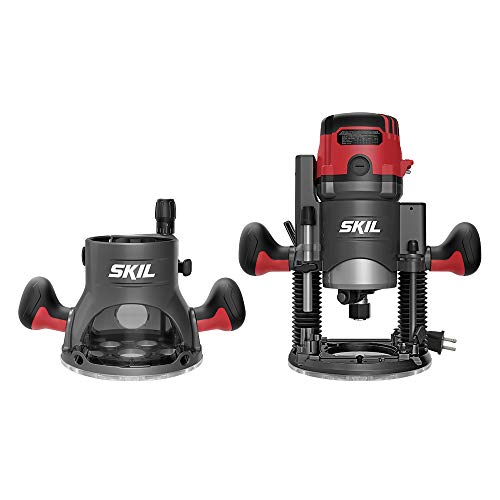
SKIL 14 Amp 2.5 HP Router Combo
Best for: Users needing fixed and plunge bases together
- Horsepower
- 2.5 HP
- Base Type
- Fixed and Plunge Combo
- Amperage
- 14 A
- Power Source
- Corded
- Dimensions
- 10 × 14.4 × 10.4 inches
- Weight
- 14.3 pounds
The SKIL RT1322-00 is a corded router with a 14 Amp motor rated at 2.5 HP. It includes both fixed and plunge bases. Electronic feedback maintains RPM under load, while soft start ensures controlled operation. An LCD display suggests speeds based on material. This combo suits users who need versatile base options in a single tool without buying separate units.
- 14 Amp, 2.5 HP motor provides strong cutting power.
- Includes both fixed and plunge bases for versatility.
- Electronic feedback maintains consistent RPM during routing.
- LCD display offers speed suggestions for specific tasks.
- 14.3 pound weight is higher than compact competitors.
- 2.5 HP rating is lower than the 2.25 HP peak ratings of some rivals.
- Standard size limits deep plunge capacity compared to dedicated plunge models.
- You need both fixed and plunge bases in one purchase.
- You prefer electronic speed control and soft start features.
- You work with standard sized routers and do not require extreme power.
- You require a cordless tool for mobility.
- You need a dedicated high-horsepower router for heavy stock removal.
- You prefer a lighter, compact tool for detailed trim work.
Verdict: SKIL 14 Amp 2.5 HP Router Combo offers a practical base combination for general woodwork. It fits users who want dual bases without managing separate tools.

Makita RT0701C 1-1/4 HP Fixed Router
Best for: precise fixed-base routing tasks
- Horsepower
- 1-1/4 HP
- Base Type
- Fixed
- Speed Range
- 10,000-30,000 RPM
- Form Factor
- Compact
- Dimensions
- 10 × 8 × 6 inches
- Weight
- 3.9 pounds
This Makita fixed-base router offers 1-1/4 HP power with a variable speed range of 10,000 to 30,000 RPM. It features electronic speed control to maintain constant RPM under load and a soft start for smooth operation. The compact design weighs 3.9 pounds and measures 10 by 8 by 6 inches. It includes a rack and pinion depth adjustment system and a quick-release cam lock. This tool suits users who need precise, steady performance in a manageable form factor.
- Variable speed dial ranges from 10,000 to 30,000 RPM
- Electronic speed control maintains constant speed under load
- Soft start feature ensures smooth startup
- Smooth rack and pinion fine depth adjustment system
- Quick release cam lock for easy base adjustments
- 1-1/4 HP motor is less powerful than the 2.25 HP options on this list
- Fixed base only, lacking the plunge capability of other models
- 3.9 pound weight is heavier than the compact cordless alternatives
- You need a dedicated fixed-base router for template work
- You prefer electronic speed control for consistent cutting performance
- You want a compact tool that fits in smaller workspaces
- You require a plunge base for mortising or edge work
- You need maximum power for heavy stock removal
- You prefer a battery-powered tool for cordless convenience
Verdict: Makita 1-1/4 HP Compact Fixed Router is a solid choice for woodworkers who prioritize precise depth control and constant speed in a fixed-base setup. It fits users who value electronic regulation and ergonomic handling over raw horsepower or plunge functionality.

DEWALT 20V MAX XR 2-1/4 HP Plunge Router
Best for: Heavy-duty cordless routing tasks
- Horsepower
- 2-1/4 Peak HP
- Base Type
- Plunge
- Speed Range
- 11,000-23,000 RPM
- Power Source
- Cordless
- Voltage
- 20V MAX
- Configuration
- Bare Tool
This is a cordless plunge router with a 2-1/4 peak HP motor and a variable speed range of 11,000 to 23,000 RPM. It weighs 11.3 pounds and includes an anti-rotation system for safety. You will get precise depth control through a tool-free adjustment system. This model suits users who need high power in a portable format for tough routing tasks.
- 2-1/4 peak HP motor for high power output
- Variable speed dial with constant speed under load
- Integrated dust collection with AIRLOCK compatibility
- Anti-rotation system shuts down if motion is excessive
- Lower no-load speed range than the DEWALT 12-Amp fixed base model
- Heavier build at 11.3 pounds compared to compact cordless options
- Bare tool configuration requires separate battery purchase
- You need cordless power for heavy-duty routing
- You want precise depth control with micro-fine adjusters
- You prefer anti-rotation safety features
- You want a lighter compact router for detail work
- You prefer a fixed base configuration
- You need a complete kit with battery and charger
Verdict: DEWALT 20V MAX XR Plunge Router delivers substantial power for users who prioritize torque and safety in a cordless format. It fits professionals who need to move between jobs without cord constraints.

DEWALT 2-1/4 HP Fixed Base Router
Best for: heavy-duty fixed-base routing tasks
- Horsepower
- 2-1/4 HP
- Base Type
- Fixed Base
- Speed Range
- 8,000-24,000 rpm
- Power Source
- Corded
- Amperage
- 12-Amp
- Speed
- Variable Speed
This corded DEWALT router delivers 2-1/4 HP through a 12-amp motor. It features variable speed control from 8,000 to 24,000 RPM with soft start. The fixed base includes micro-fine depth adjustment in 1/64-inch increments. Weighing 9.57 pounds, it offers solid performance for hardwoods. It suits users who prefer corded power and precise depth settings for stationary routing tasks.
- 2-1/4 HP motor handles tough hardwoods
- Variable speed range of 8,000-24,000 RPM
- Micro-fine depth adjustment in 1/64-inch increments
- Soft start reduces start-up torque
- Fixed base limits plunge routing capabilities
- 9.57-pound weight is heavier than compact cordless alternatives
- Corded design restricts mobility compared to battery tools
- You need high torque for dense hardwoods
- You require precise micro-adjustments for depth
- You prefer the consistent power of a corded connection
- You need plunge routing functionality
- You prioritize lightweight portability for overhead work
- You want to work without a power cord
Verdict: DEWALT 2-1/4 HP Fixed Base Router provides robust power and precise control for stationary woodworking. It fits users who prioritize motor strength and depth accuracy over cordless flexibility.
Specifications side by side
| Spec | Bosch 2.25 HP Fixed-Base Wood Router | Milwaukee 18V Cordless Compact Router | Makita 18V Brushless Compact Router | Bosch 2.25 HP Combination Router | SKIL 14 Amp 2.5 HP Router Combo | Makita RT0701C 1-1/4 HP Fixed Router | DEWALT 20V MAX XR 2-1/4 HP Plunge Router | DEWALT 2-1/4 HP Fixed Base Router |
|---|---|---|---|---|---|---|---|---|
| Horsepower | 2.25 HP | – | – | 2.25 HP | 2.5 HP | 1-1/4 HP | 2-1/4 Peak HP | 2-1/4 HP |
| Base Type | Fixed-Base | – | – | Combination Plunge- and Fixed-Base | Fixed and Plunge Combo | Fixed | Plunge | Fixed Base |
| Speed Range | 8000-25,000 RPM | 10,000 – 31,000 RPM | 10,000-30,000 RPM | 8,000-25,000 RPM | – | 10,000-30,000 RPM | 11,000-23,000 RPM | 8,000-24,000 rpm |
| Power Source | – | Cordless | Cordless | – | – | – | Cordless | Corded |
| Amperage | 12 AMP | – | – | 12-AMP | 14 A | – | – | 12-Amp |
| Voltage | – | 18.0 V | 18 V | – | – | – | 20V MAX | – |
| Motor Type | – | Brushless | Brushless | – | – | – | – | – |
| Speed | Variable Speed | – | – | Variable Speed | – | – | – | Variable Speed |
| Intended Use | Woodworking | – | – | Woodworking | – | – | – | – |
| Form Factor | – | Compact | Compact | – | – | Compact | – | – |
| Motor Power | – | – | – | – | – | 4 HP | 4 HP | 4 HP |
| Configuration | – | – | – | – | – | – | Bare Tool | – |
| Set Type | – | – | – | – | – | – | Tool Only | – |
| Weight | 9.92 pounds | 4.78 pounds | – | 18.2 pounds | 14.3 pounds | 3.9 pounds | 11.3 pounds | 9.57 pounds |
| Dimensions | – | 4.79 × 3.23 × 6.86 inches | 6.2 × 8.5 × 5.8 inches | 6 × 11.5 × 11.6 inches | 10 × 14.4 × 10.4 inches | 10 × 8 × 6 inches | – | 10.8 × 9.5 × 7.25 inches |
| Size | 6 in | – | 6.2 x 8.5 Inches | 6 in | Standard | One Size | One Size | One Size |
| Color | Black | Black | Teal | Black | Multi | Teal | Black, Yellow | Yellow |
| Model | 1617EVS | 2723-20 | XTR01Z | 1617EVSPK | RT1322-00 | RT0701C | DCW620B | DW618 |
If you need networking equipment instead of woodworking tools, use the wifi router buying guide to compare wireless specifications.
Frequently asked questions
Is a 2.25 HP router too powerful for home use?
No, a 2.25 HP router provides robust power for stationary tasks and router table use. It offers torque stability for dense hardwoods without stalling. Models like the Bosch 1617EVS deliver precise control for serious woodworkers who value strength over portability. This power level ensures consistent cuts for edge profiling and large bit operations.
How much does a compact cordless router weigh?
Compact cordless routers are significantly lighter than heavy-duty corded models. The Milwaukee 2723-20 weighs 4.78 pounds, while the Makita XTR01Z weighs approximately 4.78 pounds when considering similar compact form factors. This reduced weight aids in portable detail work and edge profiling, making them ideal for users who prioritize maneuverability over raw torque.
What is the difference between a fixed base and a combination router?
A fixed base locks the motor at a set depth for consistent cuts, offering superior stability for router tables. A combination router, like the Bosch 1617EVSPK, includes versatile base options. It fits users who need high torque and stability but also want the flexibility to switch bases for different project requirements without managing separate tools.
Do brushless motors make a difference in cordless routers?
Yes, brushless motors improve efficiency and extend battery life in cordless tools. The Makita XTR01Z features a brushless motor, which supports precise speed adjustments and detailed trim work. This technology allows users to value portability and precision over raw power, making it suitable for tasks where cordless convenience matters most.
Which router is best for heavy-duty cordless tasks?
The DEWALT DCW620B is designed for heavy-duty cordless routing tasks. It delivers substantial power with a 2-1/4 HP output, prioritizing torque and safety. This model fits professionals who need to move between jobs without cord constraints. Its 11.3-pound weight balances power with manageable handling for demanding woodworking applications.
Can I use a fixed base router in a router table?
Yes, fixed base routers are ideal for router table use. They lock the motor at a set depth, providing superior stability and consistent cuts. The Bosch 1617EVS and DEWALT DW618 are both designed for this purpose. Their fixed-base design ensures precise depth control and motor strength, which are critical for stationary woodworking tasks.
What voltage is standard for professional cordless routers?
Professional cordless routers typically use 18V or 20V MAX battery platforms. The Milwaukee 2723-20 and Makita XTR01Z operate on 18V systems, offering compact form factors for detail work. The DEWALT DCW620B uses a 20V MAX system for higher torque. These voltages provide sufficient power for portable precision while maintaining ergonomic handling.
See also
Where to buy
at Amazon
Price taken from the listing when this page was written and it can change at any time. We may earn a commission if you buy through this link.


Get our picks by email
New reviews and the prices we spotted, once a week.